|
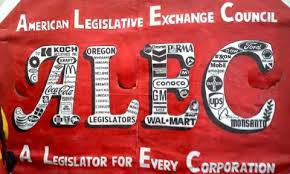
On Thursday, Dec. 6, APWU national officers and HQ employees took to the D.C. streets with labor and activist allies in protest against the American Legislative Exchange Council (ALEC). Yesterday the shadowy right-wing group known for pushing its anti-worker agenda in the states, was paid a visit by APWU and allies who shed some light on the secretive and destructive practices.
Grassroots Coordinator Matt Kent (middle) spelled out just what ALEC stands for, in the left photo below. In the center photo, Legislative and Political Director John Marcotte and Grassroots Coordinator Melissa Matos highlight ALEC's extreme anti-worker agenda.
Grassroots Coordinator Janice Kelble joined in yesterday's nationwide demonstrations in support of living wages for fast food workers. Janice took the photo on the right at McDonald's in Manchester NH as protesters called upon the fast food giant to "Deck the Halls with Higher Wages."
  
Walmart Workers & Labor Groups Protest Poverty Wages on Black Friday
Every year growing numbers of Walmart employees, union groups – especially with the coordination and leadership of the United Food and Commercial Workers Union, AFL-CIO (UFCW) and Service Employees International Union (SEIU) –and ordinary citizens have gathered at Walmart stores across the country on Black Friday to protest the poor wages and working conditions maintained by the nation’s largest employer.
The average Walmart associate makes $8.81 per hour. At that wage, if an associate works 40 hours a week and 52 weeks a year their annual income would only be $18,324. That is less than the current federal poverty level of $23,570! However, many Walmart workers do not work full-time and kept in perpetual part-time positions. At these substandard wages many Walmart employees have to resort to seeking public assistance for food and housing to sustain their living. This is gravely unfair to Walmart workers as well as taxpayers who must subsidize poverty wages to protect Walmart’s profits.
Walmart’s practices devastate the local community economies and affect all workers by depressing wages. The APWU strongly supports living wages for all employees and the efforts of your union brothers and sisters in the fight against Walmart and poverty wages.
To get the facts on Walmart’s employment practices, please click here.
From Picket Lines to Ballot Boxes, Workers Are Raising Their Voices for Higher Wages
The fight for better wages and working conditions is heating up on picket lines and on ballots throughout the country. Workers and their communities are sick and tired of waiting for their employers and for Congress to take long overdue action.
In September California signed into law an increase in minimum wage from the current rate of $8 an hour to $9 in 2014 and $10 on in January of 2016. November elections also brought long overdue increases for low wage workers in New Jersey and in Sea Tac, Washington. The Sea Tac initiative requires a $15 minimum wage along with a provision for paid sick leave while the NJ measure will raise the minimum wage by $1, to $8.25 per hour, with an automatic annual cost of living increase. New York, Connecticut, and Rhode Island have also raised their minimum wages this year.
Other parts of the country are gearing up as well. With the help up 4,500 volunteers “Raise Up Massachusetts” recently succeeded in collecting over a quarter of a million signatures needed to place the issues of minimum wage and “earned sick time” on the November ballot. Similar efforts are underway in South Dakota and Idaho.
In breaking news from Washington D.C., on Dec. 3 the D.C. Council voted unanimously to increase the minimum wage to $11.50 an hour. The Council vote still faces action by D. C. Mayor Vincent Gray, who has advocated for a raise in the minimum wage, but favors a smaller increase than was adopted by the Council.
With recent job growth occurring primarily in low-wage industries such as food and retail services increasing the minimum wage has become a huge priority for working families who rely on these wages to make ends meet. To see a list of America’s largest low-wage employers, click here.
As large low-wage employers have recovered from the recession and are earning record profits, there is little excuse for workers’ wages to remain stagnant. If wages for workers had kept pace with pay for the top 1%, the minimum wage would have climbed to $28.34! Let’s support our brothers and sisters and be a part of the movement to build an economy that works for everyone, not just the top 1%.
For more information on the impact of raising the minimum wage, click here.
|