|
On Thursday, fast-food and other low-wage workers in more than 100 cities will stage a one-day strike to boost their campaign for a living wage and justice. Rallies and other actions are planned for another 100 cities. The workers and the faith, community and labor groups that back them are calling for a living wage of $15 an hour and the right to form a union without retaliation.
Follow the action on Twitter with the hashtags #FastFoodStrikes and #HardWorkFairPay.
The mobilization for a living fast-food wage began a little more than a year ago with walkouts and protests in a handful of cites and has grown to include low-wage retail and other workers, with even bigger actions in the spring and summer.
Fast food is a $200 billion a year industry and retail is a $4.7 trillion industry, yet many service workers across the country earn minimum wage or just above it and are forced to rely on public assistance programs to provide for their families and get health care for their children.
According to National Employment Law Project, the government spends some $7 billion a year on public assistance for fast-food workers alone. Those are our tax dollars at work, not fast food’s, which makes $7.4 billion in profits.
A recent study by the UC Berkeley Labor Center and the University of Illinois at Urbana-Champaign found:
- Fast-food jobs pay so little that 52% of the families of front-line fast-food workers need to rely on public assistance programs.
- Compared to the overall economy, fast-food jobs are twice as likely as other jobs to pay so little that workers are forced to rely on public assistance (52% vs. 25%).
- Full-time jobs in the corporate fast-food industry do not pay enough for workers to get by. Even at 40 hours a week, more than half of front-line fast-food workers are forced to rely on public assistance to cover basic needs like food, rent and health care.
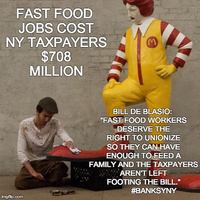
- In New York, the public cost of low-wage fast-food jobs is $708 million—the second highest in the country–with 60% of fast-food workers forced to rely on public assistance to cover basic needs. Other states in which low-paying fast-food jobs cost taxpayers the most include California at $717 million, Texas at $556 million, Illinois at $368 million and Florida at $348 million.
- 67% of core front-line fast-food workers are adults 20 and older, and 68% are the main earners in their families. More than one-quarter are raising children.
Find out more at Fast Food Forward and Fight for 15.
|