|
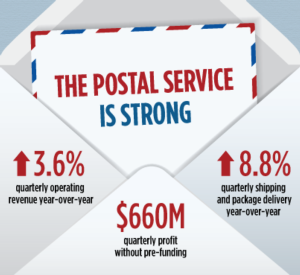
The Postal Service has released its financial figures for the third quarter of Fiscal Year 2013, which covers April, May and June. “The latest quarterly report makes clear that its finances are rebounding strongly as the U.S. economy improves,” NALC President Fredric Rolando said. “The agency would have reported a profit of $660 million absent the $1.4 billion payment it was charged for pre-funding future retiree health benefits—a bill no other company or agency in the country is required to pay.
Postal finances are improving as the economy improves. Operating revenue grew by 3.6 percent in the third quarter compared to the same period last year, and expenses were down.
Shipping and package delivery revenue is increasing dramatically, up 8.8 percent this quarter compared to the same period last year, and up 7.5 percent on a YTD basis. Revenue from shipping and package delivery has steadily increased over the past three years. The growth resulting from an exploding e-commerce sector is increasingly offsetting the negative impact of online communication and bill payment on First Class mail.
If not for pre-funding, USPS would have reported a profit through the third quarter this year. In 2006, Congress passed a law mandating that the Postal Service “pre-fund” future retiree health care decades in advance on an accelerated schedule. From 2007 to 2012, these payments accounted for nearly 80 percent of the Postal Service’s reported losses, and if not for pre-funding, the Postal Service would have reported a $660 million profit in the third quarter of FY 2013. Year-to-date, without pre-funding, USPS also would be profitable.
This mandate costs the Postal Service billions each year. USPS has already put aside almost $50 billion to cover the health premiums of its future retirees for decades. The Postal Service is the only organization, company or agency in the country required by law to pre-fund retiree health benefits.
The solution is obvious – eliminate mandatory pre-funding and free the Postal Service to take full advantage of the growth opportunities offered by the digital era.
|